If your goal is Bluetooth tracking, IoT deployment, or indoor positioning, the question “which Bluetooth 5.x version should I use?” is critical. The answer depends on your application, device density, and performance priorities—not just the newest version number.
Choose Bluetooth 5.0 for extended range and baseline reliability.
Choose Bluetooth 5.1 for precise indoor positioning using direction-finding (AoA/AoD).
Choose Bluetooth 5.2 for power efficiency, multi-stream audio, and better device coordination.
Choose Bluetooth 5.3 for dense IoT networks, high interference environments, and battery optimization.
Understanding these differences ensures your Bluetooth RTLS, warehouse tracking, or IoT system is both cost-effective and high-performing.
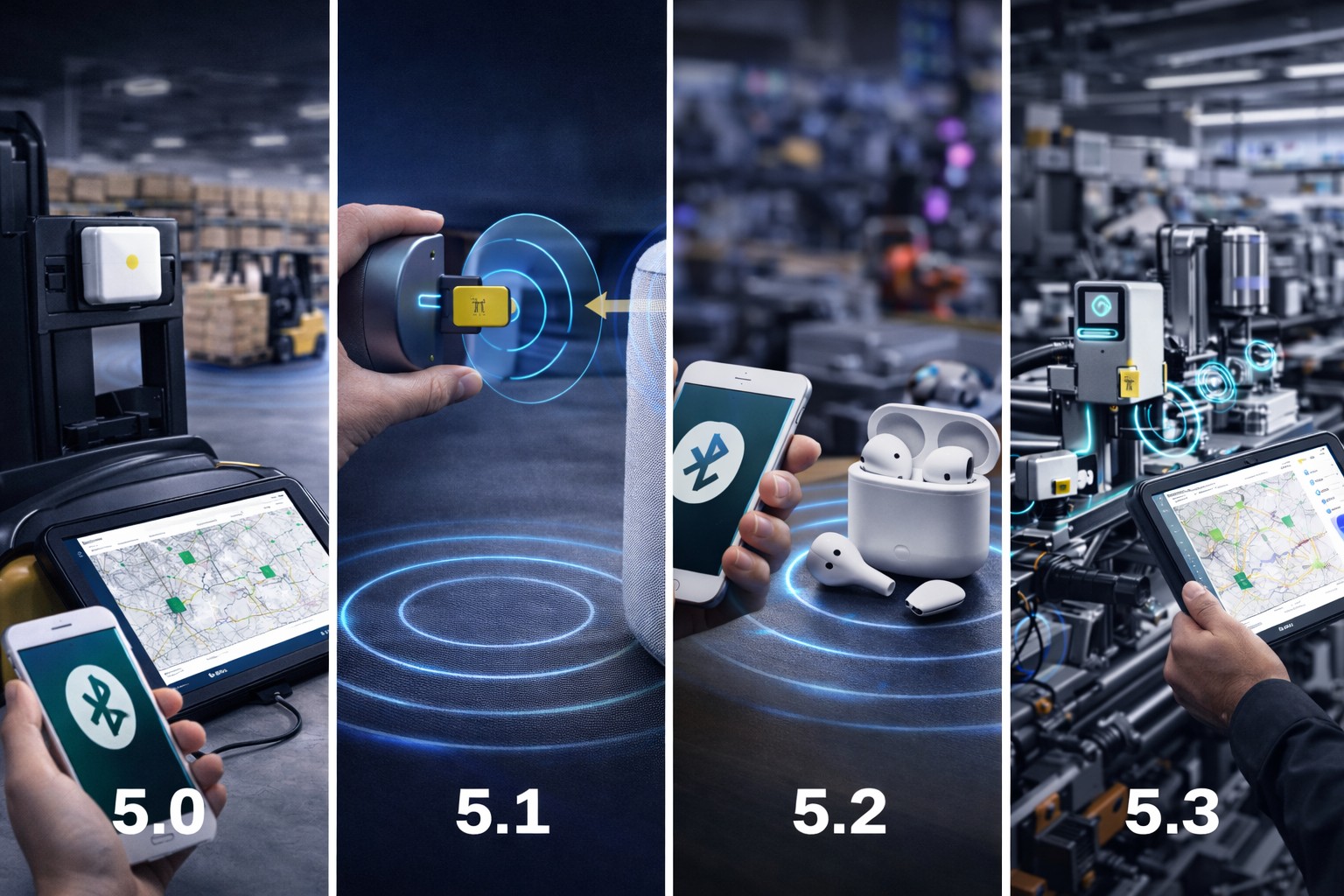
What Changed from Bluetooth 5.0 to 5.3?
Bluetooth 5.x versions build incrementally, improving efficiency, power optimization, connection stability, and directional accuracy, rather than focusing solely on raw speed. Understanding these differences is crucial for IoT deployments, Bluetooth tracking systems, and RTLS solutions.
Version | Key Feature | Practical Benefit | Typical Applications |
Bluetooth 5.0 | Extended range & speed | Provides long-range connectivity up to 240 meters outdoors (30–60 m indoors), 2 Mbps maximum data rate, larger advertising packets, and enhanced broadcast features | General IoT networks, warehouse asset tracking, retail device monitoring, basic Bluetooth tracking |
Bluetooth 5.1 | Direction finding (AoA/AoD) | Enables precise indoor positioning using Angle of Arrival and Angle of Departure, allowing devices to determine both distance and direction | Indoor RTLS, asset tracking in warehouses, personnel tracking, smart building navigation |
Bluetooth 5.2 | LE Audio & enhanced power control | Supports low-energy multi-stream audio, improved power efficiency, isochronous channels for synchronized device communication | Wearables, multi-device coordination in IoT networks, audio-enabled tracking devices, energy-sensitive deployments |
Bluetooth 5.3 | Stability & interference management | Reduces connection latency, manages interference more effectively, optimizes periodic advertising, lowers energy consumption for longer battery life | Dense IoT networks, high-interference industrial environments, large-scale Bluetooth tracking deployments with hundreds or thousands of devices |
Expanded Insights and Deployment Considerations
Bluetooth 5.0:
Provides stable baseline performance.Best for general IoT tracking, small- to medium-scale deployments, or when cost efficiency is a priority.
Still widely used in warehouses, retail stores, and logistics environments.
Bluetooth 5.1:
First version supporting real direction-finding。
Essential for high-accuracy indoor tracking, e.g., locating assets, medical equipment, or personnel in hospitals.
Compatible with RTLS solutions that require sub-meter accuracy.
Bluetooth 5.2:
Introduces LE Audio and enhanced power control, improving energy efficiency across multiple devices.
Useful when deploying audio-enabled tracking devices, smart wearables, or devices needing synchronized communication in IoT networks.
Does not improve tracking accuracy; the focus is on efficiency and device coordination.
Bluetooth 5.3:
Optimized for dense networks and high-interference environments.
Reduces packet collisions and connection dropouts.
Improves battery life in large deployments with hundreds or thousands of devices.
Ideal for industrial IoT, smart warehouses, or retail operations with high device density.
Key takeaway: Choose a version based on operational requirements—range, indoor positioning, power efficiency, network density—not simply the latest specification number.
Technical Comparison: Bluetooth 5.x Versions
Feature | 5.0 | 5.1 | 5.2 | 5.3 |
Max Data Rate | 2 Mbps | 2 Mbps | 2 Mbps | 2 Mbps |
Theoretical Range | 240 m outdoor | Similar | Similar | Similar |
Indoor Positioning | Basic | Direction-finding AoA/AoD | Basic | Basic |
Power Efficiency | Moderate | Moderate | High | High |
Network Scalability | Standard | Moderate | High | Optimized for dense networks |
Best For | General IoT & tracking | Indoor RTLS & navigation | Multi-device networks, audio IoT | Dense IoT, industrial tracking, high-interference environments |
Practical Use Cases
Warehouse Tracking:
5.0: Basic asset monitoring
5.1: Precise location of pallets or forklifts
5.3: Large warehouses with hundreds of tags, avoiding interference
Healthcare & Hospitals:
5.1 for equipment and personnel tracking
5.2 for wearables and multi-stream devices
5.3 for dense device environments in large hospitals
Retail & Smart Stores:
5.0 for small stores
5.4 (future) for ESL and synchronized devices
5.3 for high-density smart retail environments
How Bluetooth 5.x Versions Improve Real-World Performance
Bluetooth 5.x versions improve real-world performance through incremental enhancements in range stability, indoor positioning capability, power efficiency, interference management, and large-scale device coordination rather than focusing only on maximum transmission speed.
Bluetooth 5.0 introduced longer communication range, larger advertising packets, and improved broadcast capability, making it suitable for general IoT deployments and Bluetooth tracking systems. Bluetooth 5.1 added direction-finding technologies such as AoA and AoD, significantly improving indoor positioning accuracy for RTLS and navigation applications.
Bluetooth 5.2 focused primarily on communication efficiency through LE Audio, isochronous channels, and improved power management, helping multi-device IoT systems maintain more stable synchronization and lower energy consumption. Bluetooth 5.3 further optimized dense wireless environments by improving interference management, reducing packet collisions, and enhancing battery efficiency across large-scale deployments.
These improvements allow Bluetooth 5.x technologies to support increasingly complex operational environments including industrial IoT, smart warehouses, healthcare RTLS, retail tracking systems, and large connected device ecosystems.
Bluetooth 5.x Range and Indoor Positioning Evolution
Bluetooth 5.x versions progressively improve wireless communication range and indoor positioning capability depending on deployment requirements and operational priorities.
Bluetooth 5.0 established the foundation for long-range BLE communication by supporting extended wireless coverage and larger advertising payloads. This made Bluetooth more practical for IoT tracking systems, warehouse monitoring, and large-area device deployments.
Bluetooth 5.1 introduced direction-finding technologies including Angle of Arrival (AoA) and Angle of Departure (AoD), allowing Bluetooth devices to determine signal direction instead of relying only on RSSI signal strength estimation. This significantly improved indoor positioning precision and enabled Bluetooth RTLS systems to support sub-meter positioning accuracy across complex indoor environments.
Bluetooth 5.2 and 5.3 maintained similar positioning capability while improving overall communication efficiency, synchronization stability, and interference resilience in large-scale wireless deployments. These optimizations are particularly important in environments containing hundreds or thousands of connected Bluetooth devices operating simultaneously.
Bluetooth 5.x Speed and Communication Efficiency Comparison
Although Bluetooth 5.0, 5.1, 5.2, and 5.3 maintain similar maximum theoretical data rates, each version improves communication efficiency differently depending on operational priorities.
Bluetooth 5.0 introduced 2 Mbps PHY mode and larger advertising packet capability, improving throughput and long-range communication efficiency. Bluetooth 5.1 focused less on speed improvements and more on positioning precision through direction-finding functionality.
Bluetooth 5.2 improved communication coordination through isochronous channels and LE Audio support, enabling more synchronized device communication and better power efficiency across multi-device environments. Bluetooth 5.3 further optimized communication stability by reducing retransmissions, minimizing packet collisions, and improving performance in dense wireless networks.
As a result, later Bluetooth versions often deliver stronger real-world communication stability and operational scalability even when theoretical transmission speeds remain unchanged.
Frequently Asked Questions (FAQ)
1. Is Bluetooth 5.3 faster than 5.0?
No. Maximum data rates remain similar. 5.3 focuses on stability, interference management, and energy efficiency, crucial for dense IoT and industrial tracking networks.
2. Does Bluetooth 5.1 improve tracking accuracy?
Yes. 5.1’s direction-finding (AoA/AoD) enables precise indoor positioning. Later versions maintain accuracy but do not increase precision.
3. Is Bluetooth 5.2 required for IoT deployments?
Not necessarily. 5.2 improves power efficiency and multi-stream audio, but most IoT tracking systems operate effectively on 5.0.
4. Is Bluetooth 5.0 still relevant today?
Yes. Offers strong range, reliability, and compatibility, sufficient for many tracking and IoT applications.
5. Should I upgrade from 5.0 to 5.3?
Upgrade if your network has high device density or interference issues. For standard deployments, 5.0 remains sufficient.
Conclusion
Bluetooth 5.0–5.3 represents incremental, practical improvements rather than revolutionary changes.
5.0 → Extended range and baseline reliability
5.1 → Direction-finding for precise indoor tracking
5.2 → Power efficiency and multi-stream audio for device networks
5.3 → Stability, interference management, and battery optimization
Recommendation: Base your decision on deployment requirements, including range, positioning accuracy, power efficiency, and network density, rather than just the newest version number. Effective system architecture, anchor placement, and device planning remain critical for successful Bluetooth tracking and IoT deployments.
About Blueiot:
Blueiot is a global leader in real-time location systems (RTLS), delivering ultra-precise indoor tracking powered by Bluetooth Angle-of-Arrival technology.With accuracy down to 0.1 meters, Blueiot enables organizations to gain real-time visibility into people, assets, and workflows across complex indoor environments.
Trusted across manufacturing, healthcare, logistics, retail, and smart buildings, Blueiot helps businesses boost efficiency, improve safety, and make faster, data-driven decisions—turning location data into measurable operational value.
Looking to improve visibility and operational performance in your industry?
Contact Blueiot to explore a tailored RTLS solution.
Each location is meaningful!
Get real-time tracking insights and solutions tailored to your needs.
Enter your email to get our newsletter on best-in-class RTLS, AoA, and BLE solutions.

Sign-up
successful !
Our team will get in touch with you
shortly.


 Search